


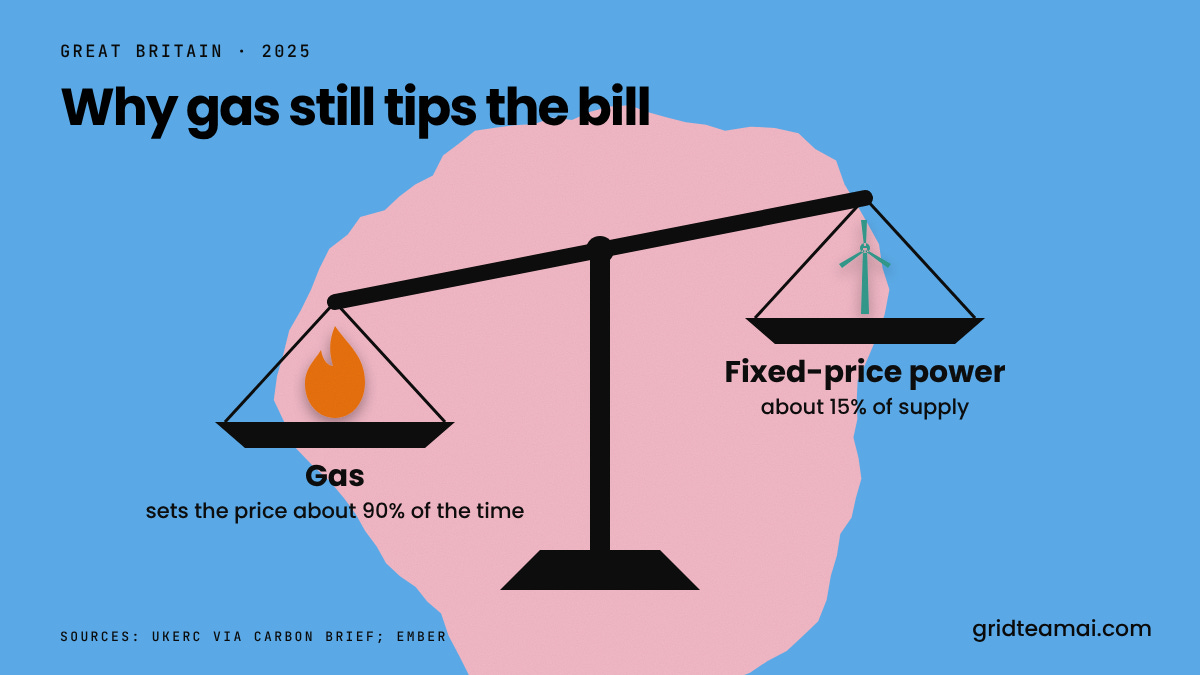

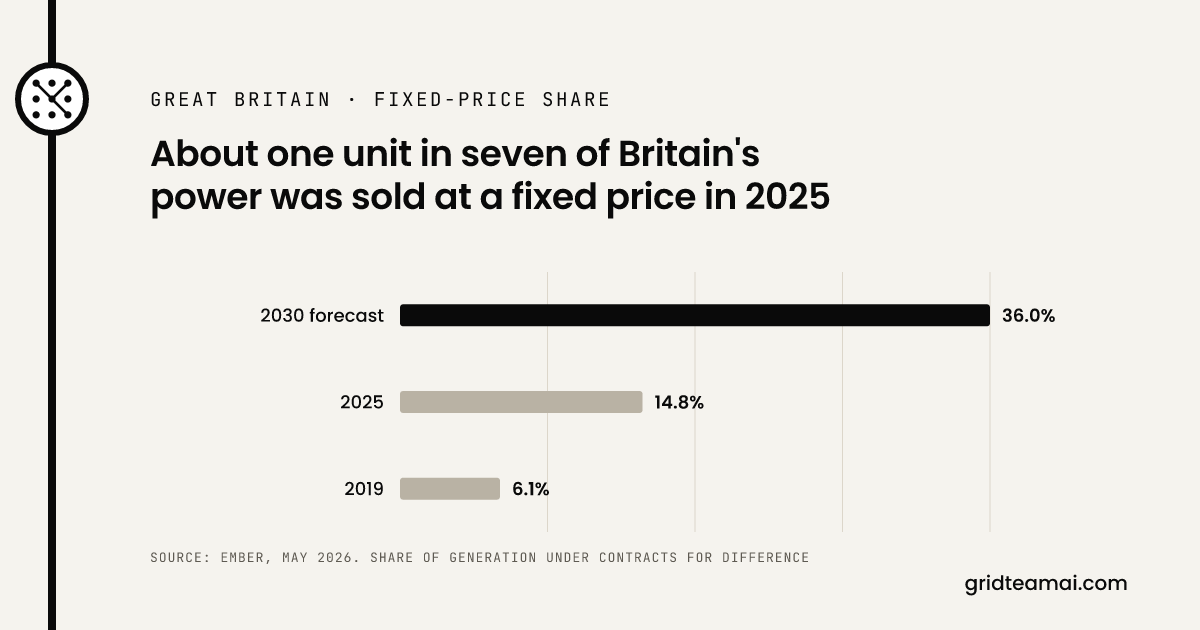
The number: about 15%. That was the share of Britain's electricity sold at a fixed price in 2025, under the government-backed deals known as Contracts for Difference, according to the energy think tank Ember. Picture seven units of power on your electricity bill, each one a kilowatt-hour. Roughly one came at a fixed price. The other six were sold at prices tied to the market, and the market mostly follows gas.
Since 5 November, the levy on electricity suppliers that pays for those deals has been £0 a megawatt-hour, a megawatt-hour being 1,000 of the kilowatt-hour units on your bill. The Low Carbon Contracts Company, the government-owned firm that runs them, set it at zero on 2 November because market prices are so high. When power is this dear, the wind and solar farms on fixed prices need no top-up from bill payers. Once the market goes above their agreed price, they pay the difference back.
What we said, what happened. On 29 October we asked how the gas standing charge, the fixed daily fee on a gas bill, would be scrapped. The Chancellor had said on 28 October that he would ask Ofgem, the energy regulator, to act. His aim is removal in 2027 or as soon as possible after. On 4 November the government said it would amend the Energy Independence Bill, introduced that day, to support the plan, but there is still no firm date.
Two wind farms on a fixed price for 20 years
On Wednesday 11 November, the energy company RWE and the investment company KKR said they would spend around £12 billion on two wind farms, Vanguard West and Vanguard East (joint announcement). The sum includes the cables and kit that bring the power ashore. Both farms sit 50 to 80 kilometres off the Norfolk coast. KKR holds half of each and RWE leads the building, the companies say, and they expect both to be fully running in 2030. The government says the farms could power the equivalent of around three million homes.
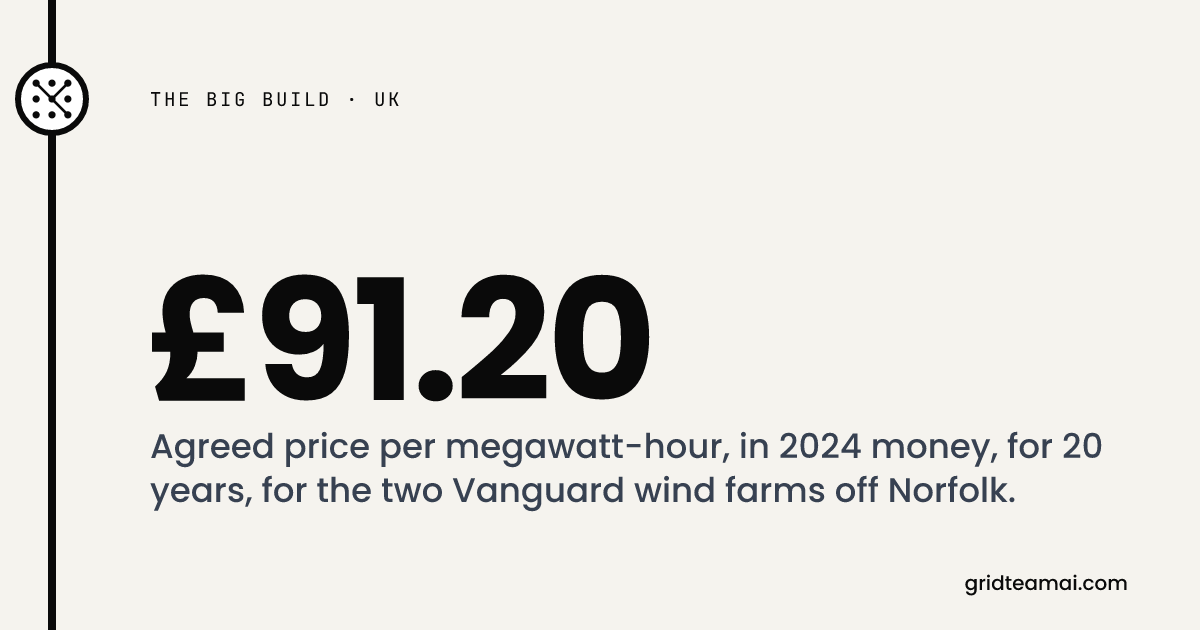
Both won Contracts for Difference in the government's seventh auction, announced in January, at £91.20 a megawatt-hour in 2024 money. That's about 9p a unit at wholesale. The round secured a record 8.4 gigawatts (GW) at sea, as Carbon Brief reported. A gigawatt, 1,000 megawatts, is roughly the output of a large power station.
The companies' announcement of 11 November gives each farm 1,400 megawatts. The auction results of 14 January list contract parts for each farm that add up to 1,545. Neither document explains the difference.
Not in the release: what the deal adds to or takes off a typical bill, and which port ships the turbines.
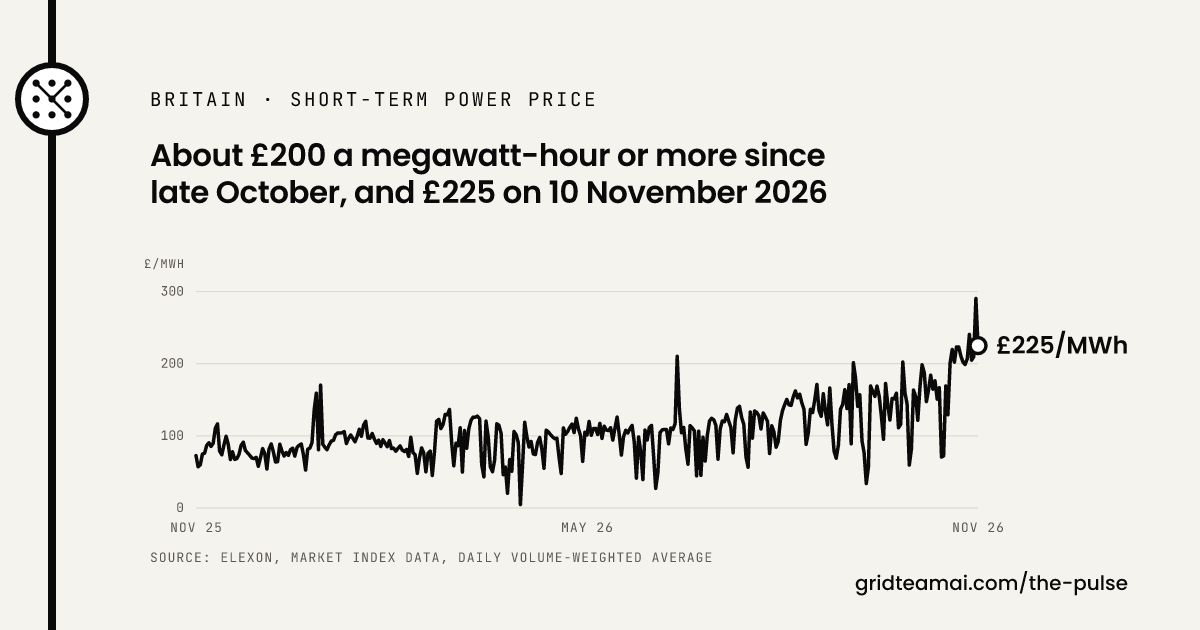
Now set the £91.20 price against the market. On Tuesday 10 November, Britain's short-term wholesale price was £225.07 for the same amount, according to Elexon, which works out who owes what in Britain's electricity market. On the same day last year it was £73.81. Every day since 28 October it has been about £200 or more, around double the contract price.
Why does gas still set the price?
Britain's wholesale price is usually set by the dearest power station needed to meet demand, and that is most often a gas plant. The UK Energy Research Centre (UKERC) estimated that gas was the price-setter about 90% of the time in 2025, Carbon Brief reported in January, and it expects 60% by 2029.
The fixed-price deals don't stop gas setting the price. They fix what the farms holding them earn, so only that slice of the market is shielded. Ember expects the slice to reach 36% by 2030, which still leaves nearly two-thirds of our power sold at market prices. Vanguard is meant to be part of that rise, but RWE expects building at sea to start only in 2027 (announcement).
Wind and solar do help in a crisis, and Ember has put a figure on it. It counted the first four weeks of this year's gas crisis, from 28 February to 28 March. Gas generation was 39% lower than in the same weeks of 2021, and Ember reckons wind and solar avoided around £7 million of gas purchases a day, after allowing for extra payments to contract holders.
It still wasn't enough to hold bills down. The price cap, Ofgem's limit on what suppliers can charge on standard tariffs, rose in May and again in October, and Uswitch says both rises came from constraints on oil and gas supplies after the closure of the Strait of Hormuz. Forecasts from British Gas, EDF and E.ON, gathered by Uswitch by 6 November, point to a further rise of about 28% in January, which Uswitch puts down to the continued effects of the war in Iran on wholesale prices. Ofgem sets the January cap on 25 November.
The wider grid waits on a February decision
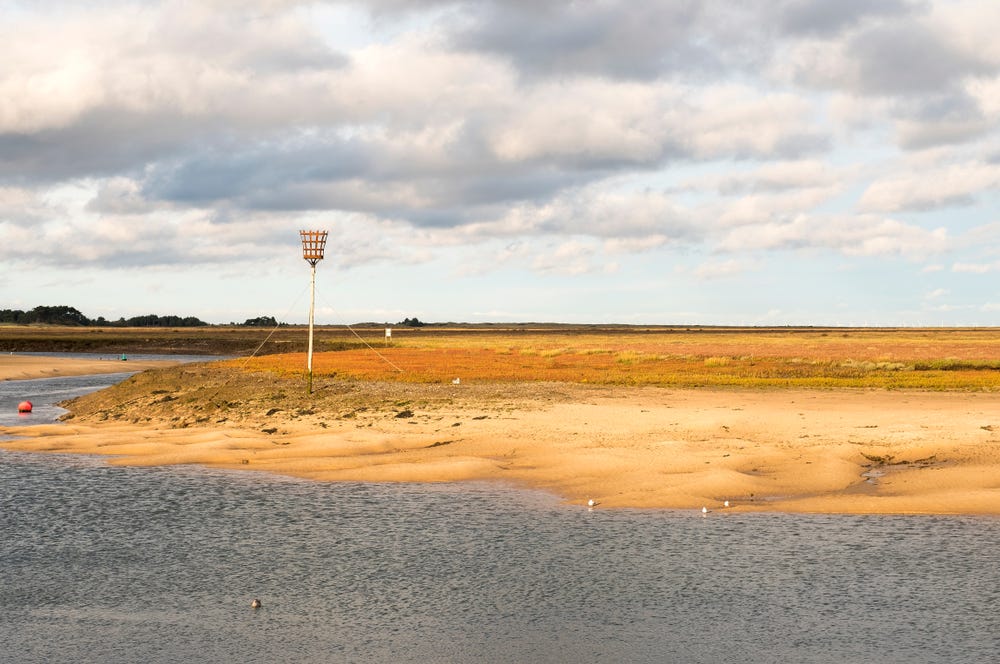
RWE said on 11 November that onshore cable works and substations for Vanguard are well advanced (announcement). National Grid wants to build Norwich to Tilbury, a new 180 km line through a region it calls "a powerhouse of offshore wind and renewable generation". The planning examiners sent their recommendation to the Energy Secretary on 10 November, and the decision is due by 10 February 2027. The companies' announcement doesn't say whether Vanguard's 2030 date depends on that line.

The Clean Power 2030 Action Plan aims for 43 to 50 GW of wind at sea by 2030. In January, Carbon Brief counted about 17 GW built, 10 GW already contracted and the auction's 8.4 GW, which still left a gap of about 7 GW to the bottom of the range. Vanguard is part of that 8.4 GW, so if it slips, the gap grows.
The date matters more than the £12 billion
The fixed price is insurance, and since 5 November the contracts already running have needed no top-up from bill payers. The weakness is how little it covers. A gas shock still sets the price of most of the power households buy, and the £12 billion changes nothing until the farms run.
The 2030 date is also the government's target year. Every year that Vanguard, or the grid behind it, slips leaves more of the power you buy exposed to gas prices.
The strongest case against us is cheap gas. A year ago the market price was £73.81, below Vanguard's £91.20, which is in 2024 money and has since risen with inflation. If prices drop back that far and stay there, the levy starts topping the farms up and the deals cost bill payers. Then the case for them rests on security rather than on this winter's sums, and a late Vanguard costs less than we suggest.
What it means for you
Your bills. Vanguard changes nothing on your bill this winter or next. If the farms run on time, gas shocks after 2030 will hit your bill less hard, though they won't go away.
Who pays, who gains. Bill payers carry the price risk in both directions. When the market pays less than the agreed price, suppliers pay a levy that tops the farms up, and that cost reaches bills. When it pays more, the farms hand back the difference, according to EMR Settlement, which runs the payments. The owners carry the building risk, because they spend the money at sea first and are paid only for power the farms produce. In return, they gain a price fixed for 20 years and rising with inflation, though they are not topped up when the market price falls below zero.
What it means for the country
The government puts the jobs at more than 2,400 across building and running the farms, but doesn't say where. RWE has named Vestas for the turbines and Lowestoft as a base for building support, but this week's announcements don't say how much of the £12 billion is spent with UK firms.
The short version
RWE and KKR say they will spend around £12 billion on two wind farms off Norfolk, at a fixed £91.20 a megawatt-hour in 2024 money for 20 years (announcement).
Only about 15% of Britain's power was sold at fixed prices like this in 2025, and gas was the price-setter about 90% of the time, so the gas shock still reaches bills.
In our view, the main risk in this deal for bill payers is delay, at sea or on the grid. Ministers decide on Norwich to Tilbury by 10 February 2027, and this week's announcement doesn't say whether Vanguard depends on it.
Jargon buster
Contract for Difference. A deal with a government-owned company that fixes what a power station earns for each unit. In a cheap market it is topped up, and in a dear one it pays back.
What we don't know yet
The pay-back. How much fixed-price farms are handing back this quarter. The levy notice of 2 November gives the rate, not the sum.
The grid. Whether Vanguard's 2030 date depends on the Norwich to Tilbury line, which ministers decide on by 10 February 2027.
The size. Which figure for each farm, 1,400 or 1,545 megawatts, will hold.
We'll keep score.
A fixed price for 20 years, or the market: which would you choose for your own bill? Hit reply and tell us, or leave a comment.
If someone you know keeps asking why bills rise while Britain builds more wind, forward this to them.
The Wire covers UK infrastructure news every weekday morning, and it's free. Recent items include the Vanguard money and the Energy Independence Bill. Our live map tracks Vanguard.
Next week: Britain's queue for grid connections, and how much of it is real.
If this was useful, tap the heart below. It helps the piece reach more readers.
See you next week.
Anthony
Sources
Ember, "British power prices are increasingly independent from gas", 13 May 2026 (Contract for Difference share of generation 6.1% in 2019, 14.8% in 2025, forecast 36% by 2030): https://ember-energy.org/latest-insights/british-power-prices-are-increasingly-independent-from-gas/
Low Carbon Contracts Company, "LCCC determines CfD ILR and TRA", 2 November 2026 (levy £0.000 a megawatt-hour from 5 November to 31 December 2026, "a result of elevated market prices"): https://www.lowcarboncontracts.uk/news/lccc-determines-cfd-ilr-and-tra/
GOV.UK, Energy Independence Bill announcement, 4 November 2026: https://www.gov.uk/government/news/energy-reforms-to-cut-bills-and-put-power-back-in-peoples-hands
RWE and KKR, joint announcement on Vanguard West and Vanguard East, 11 November 2026: https://www.rwe.com/en/press/rwe-ag/2026-11-11-rwe-and-kkr-join-forces-to-deliver-2-8-gw-of-new-offshore-wind-capacity-in-the-uk/
GOV.UK, "Prime Minister hails major investment in UK renewables", 11 November 2026 (around three million homes, more than 2,400 jobs, "believed to be the biggest of its kind in UK history to date"): https://www.gov.uk/government/news/prime-minister-hails-major-investment-in-uk-renewables
GOV.UK, Contracts for Difference Allocation Round 7 results (accessible webpage), results announced 14 January 2026: https://www.gov.uk/government/publications/contracts-for-difference-cfd-allocation-round-7-results/contracts-for-difference-allocation-round-7-results-accessible-webpage
Carbon Brief, "Q&A: What UK's record auction for offshore wind means for bills and clean power by 2030", 15 January 2026 (8.4 GW, about 17 GW built, 10 GW previously contracted, gap of about 7 GW to 43 GW): https://www.carbonbrief.org/qa-what-uks-record-auction-for-offshore-wind-means-for-bills-and-clean-power-by-2030
Elexon, market index price, daily volume-weighted average, including £73.81 on 10 November 2025, £225.07 on 10 November 2026, and £199 or more on every day from 28 October to 10 November 2026: https://bmrs.elexon.co.uk/market-index-price
Carbon Brief, "Expensive gas still biggest driver of high UK electricity bills, says UKERC", 28 January 2026 (gas set the price about 90% of the time in 2025, 60% forecast for 2029): https://www.carbonbrief.org/expensive-gas-still-biggest-driver-of-high-uk-electricity-bills-says-ukerc/
Ember, "Clean power fortifies Britain against gas price shocks", 9 April 2026, revised 15 April 2026 (28 February to 28 March 2026: gas generation 39% lower than in 2021, around £7 million of gas purchases avoided a day, net of extra Contract for Difference payments): https://ember-energy.org/app/uploads/2026/04/Clean-power-fortifies-Britain-against-gas-price-shocks-PDF-1.pdf
Uswitch, "Energy price cap January 2027: latest predictions and news", updated 6 November 2026 (rises in May and October, forecast rise of 28% from British Gas, EDF and E.ON predictions): https://www.uswitch.com/gas-electricity/news/energy-price-cap-january-2027-latest-predictions-and-news/
Ofgem, changes to the energy price cap between 1 October and 31 December 2026, accessed 11 November 2026 (next cap announced 25 November 2026): https://www.ofgem.gov.uk/publications/changes-energy-price-cap-between-1-october-and-31-december-2026
EMR Settlement, Contracts for Difference, accessed 11 November 2026: https://www.emrsettlement.co.uk/about-emr/contracts-for-difference
National Grid, Norwich to Tilbury, accessed 11 November 2026 (180 km line, East Anglia "a powerhouse of offshore wind and renewable generation"): https://www.nationalgrid.com/norwich-tilbury-planning-application-accepted-key-energy-milestone
Planning Inspectorate, Norwich to Tilbury project page, EN020027 (recommendation sent to the Secretary of State 10 November 2026, decision due by 10 February 2027): https://national-infrastructure-consenting.planninginspectorate.gov.uk/projects/EN020027
GOV.UK, Clean Power 2030 Action Plan, 13 December 2024 (updated 15 April 2025, 43 to 50 GW of offshore wind by 2030): https://www.gov.uk/government/publications/clean-power-2030-action-plan
Low Carbon Contracts Company, about Contracts for Difference, accessed 11 November 2026: https://www.lowcarboncontracts.uk/our-schemes/contracts-for-difference/about/
RWE, turbine supply agreements with Vestas for Vanguard West (20 February 2026) and Vanguard East (10 March 2026), and port agreements including Lowestoft (20 March 2026): https://uk.rwe.com/press-and-news/2026-02-20-rwe-and-vestas-agree-turbine-supply-agreement-for-vanguard-west-offshore-wind-farm/ and https://uk.rwe.com/press-and-news/2026-03-20-rwe-agrees-ports-with-abp-clarksons/
GOV.UK, "Chancellor abolishes standing charges on gas bills to make payments fairer", 28 October 2026 (removal "in 2027 or as soon as possible after"): https://www.gov.uk/government/news/chancellor-abolishes-standing-charges-on-gas-bills-to-make-payments-fairer
Our sums: one unit in seven is 14.3%, close to Ember's 14.8%. £91.20 a megawatt-hour is 9.12p a kilowatt-hour. Auction contract parts of 1,380, 90 and 75 megawatts make 1,545 megawatts a farm, from item 6: https://www.gov.uk/government/publications/contracts-for-difference-cfd-allocation-round-7-results/contracts-for-difference-allocation-round-7-results-accessible-webpage