



On 11 November the research house BloombergNEF published a number built to travel, and it duly did. It counted 181 gigawatts of gas-fired power stations proposed alongside data centres, which is about four times Great Britain's peak demand. It is a fine number for a headline and a poor one for a British reader, because the release says of that capacity that "more than 90% of which is in the US", and it does not name the United Kingdom at all.
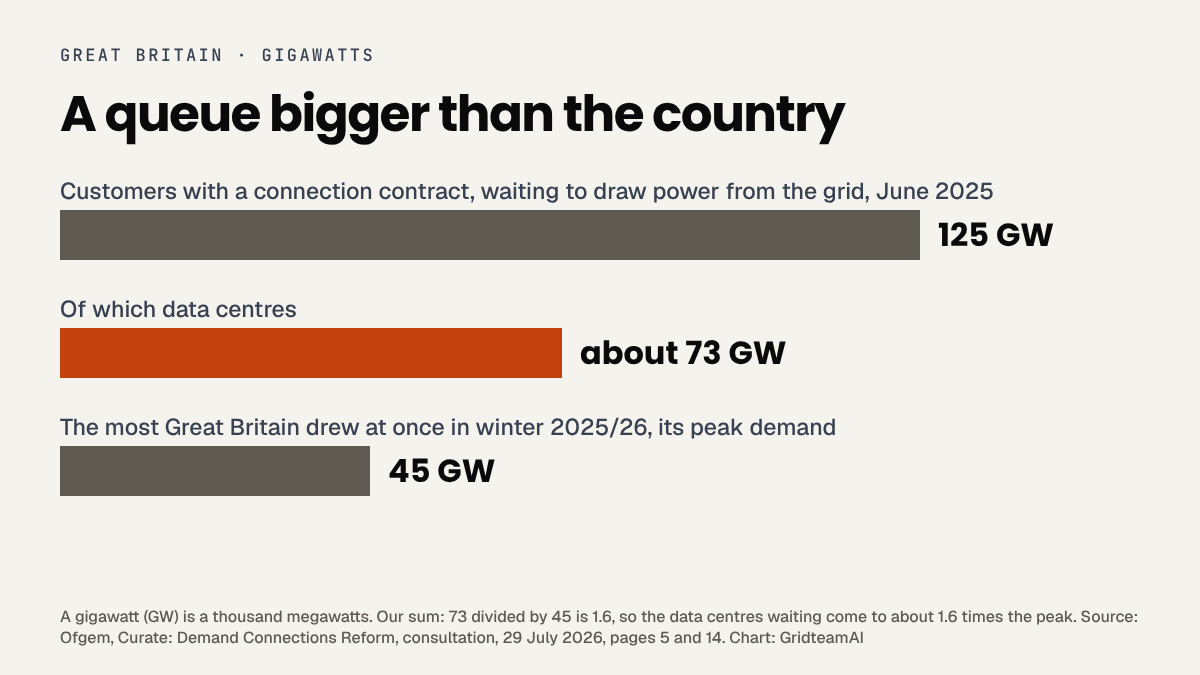
The British number is smaller and already on paper. Ofgem, the energy regulator, reported in July that the queue of customers waiting to draw power from the grid had grown from 41 gigawatts to 125 gigawatts in seven months. It added: "Of this, around 73 GW are data centres." Great Britain's peak demand in the winter of 2025-26 was 45 gigawatts.
Not everybody in that queue is waiting. In June the same regulator recorded a rise in applications to join a different network altogether, the gas grid, which it described as "principally driven by data centres aiming to achieve earlier operation". Its data from the gas networks suggested about 117 active cases, from enquiries through to formal applications. Future Energy Networks, the trade body for the gas networks, said in April that a new gas connection typically takes between six months and two years. A developer with chips on order does not need a consultant to see which queue is shorter.
Westminster, meanwhile, has been busy with the other end of the pipe. The Energy Independence Bill, introduced on 4 November, ends new licences to explore for oil and gas, and the factsheet published with it says North Sea production in 2025 was 75 per cent below its peak. We take no side on the licences. A growing use for gas and a shrinking home supply of it are simply two facts that now sit in the same pile of official paper.
The accepted view, which BloombergNEF itself reports, is that the gas is a bridge, something to run on until the grid connection arrives. It is a fair account of what developers say they intend. We think it underrates two things that sit in the public documents, and neither requires anybody to behave badly. So let us follow the pipe and see where it comes out.
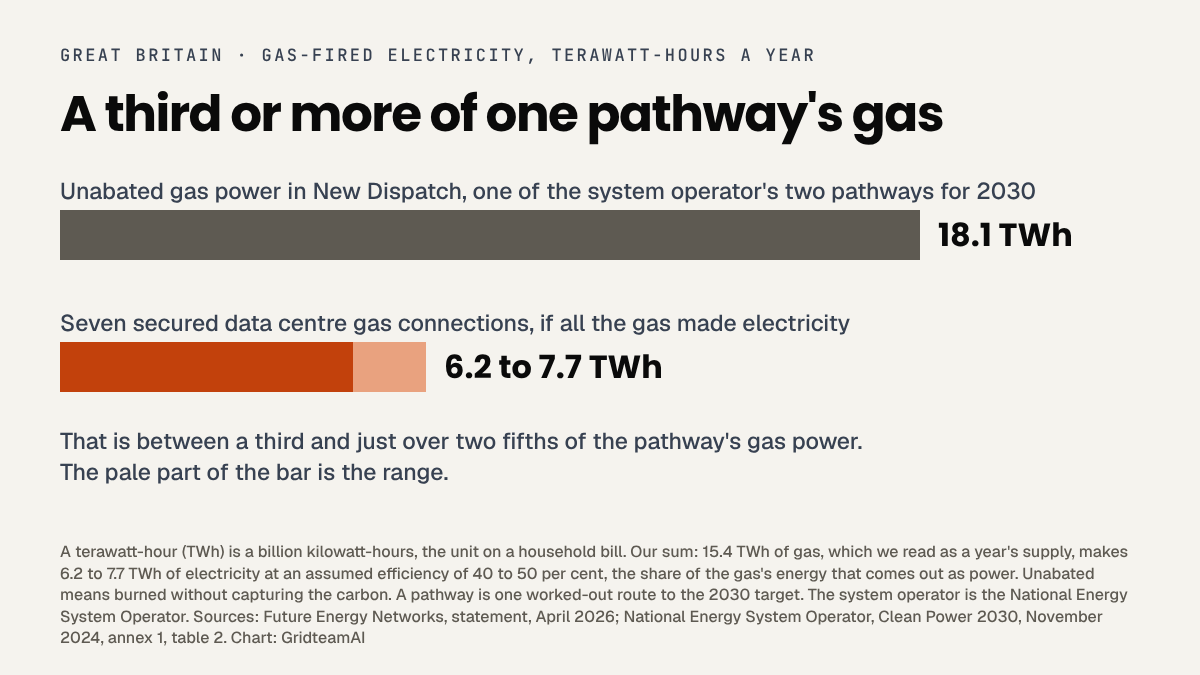
Size comes first. Future Energy Networks said in April that seven data centre applications had been secured for connection to the gas network, and that together they amount to 15.4 terawatt-hours of gas. We read that as a year's supply, because the trade body compared it to the heating of 1.3 million homes.
A different comparison is more useful. Burned in the kind of engine or turbine that fits on a data centre site, at an efficiency we have assumed to be between 40 and 50 per cent, that gas would make roughly 6 to 8 terawatt-hours of electricity. The clean power target, as the National Energy System Operator framed it, allows unabated gas, meaning gas burned without capturing the carbon, to supply less than 5 per cent of Great Britain's generation in a typical year. One of the operator's two pathways for 2030 puts gas at 18.1 terawatt-hours.
Seven connections, if they were used in full to make electricity, would come to 6 to 8 of those 18 terawatt-hours. That is between a third and just over two fifths of the gas-fired electricity that pathway allows the whole of Great Britain in 2030.
The fair objection is that secured is not built, that some of these connections may be for back-up and not for running flat out, and that many of the cases are only enquiries. It is also fair to say that a data centre which never touches the grid may not be in the operator's pathway to begin with. All of that is true, and it is also true of the 73 gigawatts in the electricity queue, which has a consultation, a proposed fee and a reform programme of its own.
The second thing is the more interesting, and it is a matter of bookkeeping. Whether gas burned behind a data centre's fence counts against the target depends on a definition, and the technical annex behind the definition does not mention data centres. The energy department's methodology, published in September 2025, says that Great Britain's generation includes "power plants, non-CHP autogeneration, and microgeneration". Autogeneration is the statistician's word for power a business makes for itself, and CHP is combined heat and power, so a plain gas engine at a data centre is inside the count.
That same page leaves combined heat and power out, and the technical annex to the government's plan explains the choice: "We are removing gas CHP generation (except gas CHP MPPs) from our calculation". The last letters stand for major power producers. The reasoning was sensible when it was written in December 2024, because such plants are not mainly there to make power and their emissions are counted in industry's share of the national carbon budget.
A data centre, though, is a building that makes heat for a living and spends a great deal of money getting rid of it. A gas engine whose waste heat is put to work cooling the halls looks a good deal like combined heat and power, and whether the statisticians would class it so is exactly the open question. We do not know how many of the 117 cases would be built that way, and the engineering case for using the heat stands on its own. If such plants are classed as combined heat and power, some or all of their gas could leave the clean power calculation, and the target could be met in the statistics in the same year that gas burned for electricity goes up.
We looked for an official answer to that question in the regulator's papers, the system operator's, the department's and Parliament's, and as far as we could find by 19 November 2026 nobody has published one.
The stake is national before it is commercial, because a target met on paper while gas burn and gas imports rise would be a strange kind of independence. For the people who build things the consequence is practical. The gas networks count about three times as many data centre enquiries in 2025 as in 2024, which is a market for pipe and engines. The cable makers and substation builders waiting on the electricity queue may find that their customer has found another way to switch on.
We could be wrong in three ways. The connections may never be used at the scale secured. The department may rule that a data centre's engine is not combined heat and power whatever it does with its heat. The electricity queue may clear faster than expected once Ofgem's reforms take effect. Each can be checked, since the clean power metrics are to be updated every year. We will put the definition question to the department and print its reply, or note the absence of one, by 18 December 2026.
A bridge, in the ordinary meaning of the word, has a far bank. A gas connection with no published end date is a pipe, and the dream is the part that is not yet connected.
We'll keep score.
Sources
BloombergNEF, press release on data centre power demand, 11 November 2026 (the address keeps the publisher's American spelling): https://about.bnef.com/insights/data-centers/data-center-power-demand-is-set-to-surge-raising-new-climate-challenges-bloombergnef/
Ofgem, "Curate: Demand Connections Reform", consultation, 29 July 2026 (executive summary, page 5, paragraph 2.7, and page 14 for the winter of the peak): https://www.ofgem.gov.uk/sites/default/files/2026-07/Proposed-data-centre-connection-reforms-curate-consultation-document.pdf
Ofgem, "Connect Update: Demand Connections Reform", 16 June 2026 (paragraph 1.13): https://www.ofgem.gov.uk/sites/default/files/2026-06/demand-connections-reform-update-June.pdf
Future Energy Networks, statement on data centre gas connection enquiries, April 2026, as published by the Institution of Gas Engineers and Managers: https://www.igem.org.uk/resource/data-centre-gas-connections-enquiries-surge-amid-electricity-grid-queues.html
Department for Energy Security and Net Zero, "Clean Power 2030 metrics: methodology", 30 September 2025: https://assets.publishing.service.gov.uk/media/68da827e49e17d00a56ffb6e/Clean_Power_2030_Metrics_methodology.pdf
Department for Energy Security and Net Zero, "Clean Power 2030 Action Plan: technical annex", December 2024 (page 7): https://assets.publishing.service.gov.uk/media/6776727f6a79200ddfa21b81/clean-power-2030-action-plan-technical-annex.pdf
National Energy System Operator, "Clean Power 2030", November 2024, annex 1 (unabated gas below 5 per cent, section 4.4.5, and the New Dispatch pathway, table 2): https://neso.energy/document/346791/download
Department for Energy Security and Net Zero, factsheet "Ending new oil and gas licences and introducing Transitional Energy Certificates", 4 November 2026: https://www.gov.uk/government/publications/energy-independence-bill-factsheets/ending-new-oil-and-gas-licences-and-introducing-transitional-energy-certificates
Our sums: 181 divided by 45 is 4.0. 15.4 terawatt-hours of gas at 40 to 50 per cent efficiency is 6.2 to 7.7 terawatt-hours of electricity. 6.2 divided by 18.1 is 34 per cent and 7.7 divided by 18.1 is 43 per cent.