



The number: 210. That is how many of the 340 projects promised a protected connection date will have the date or the connection point changed. Ofgem, the energy regulator, reported it in February. It is about six in every ten.
These were the projects furthest along. If their dates can move, so can the date on the job you are pricing.
Promised connection dates have already moved back
Britain rebuilt its queue for grid connections over the past year. The National Energy System Operator (NESO), which runs it, now makes each project one of two offers. Gate 2 is a firm offer with a date. Gate 1 is an indicative offer without a fixed date.
The firm offers are late. The original plan was to send them all by the end of September 2026. Offers for projects due by 2035 now have until 31 January 2027, and the last local-network offers until 31 March 2027.
Many of the first offers had to be sent twice. NESO's mid-year report of 23 October says 51% of the first protected offers were reissued. It also says 91% of offers for 2030 projects had gone out by 30 September.
NESO's director of connections wrote on 1 October that "issuing an offer does not deliver a project".
Behind the offers sits the network you are waiting for. The National Audit Office found in September that 50 of 56 grid upgrades were forecast to finish after what it calls their optimal date. Its figures are as at March 2026, when all 56 were under way. All are essential to the government's Clean Power plan for 2030.
The audit office also found that the government, Ofgem and NESO were not yet tracking whether connections are getting faster.
Not in the release: NESO's published results do not show how offered dates compare with the dates developers asked for.
Most of what lost its date was developers opting out
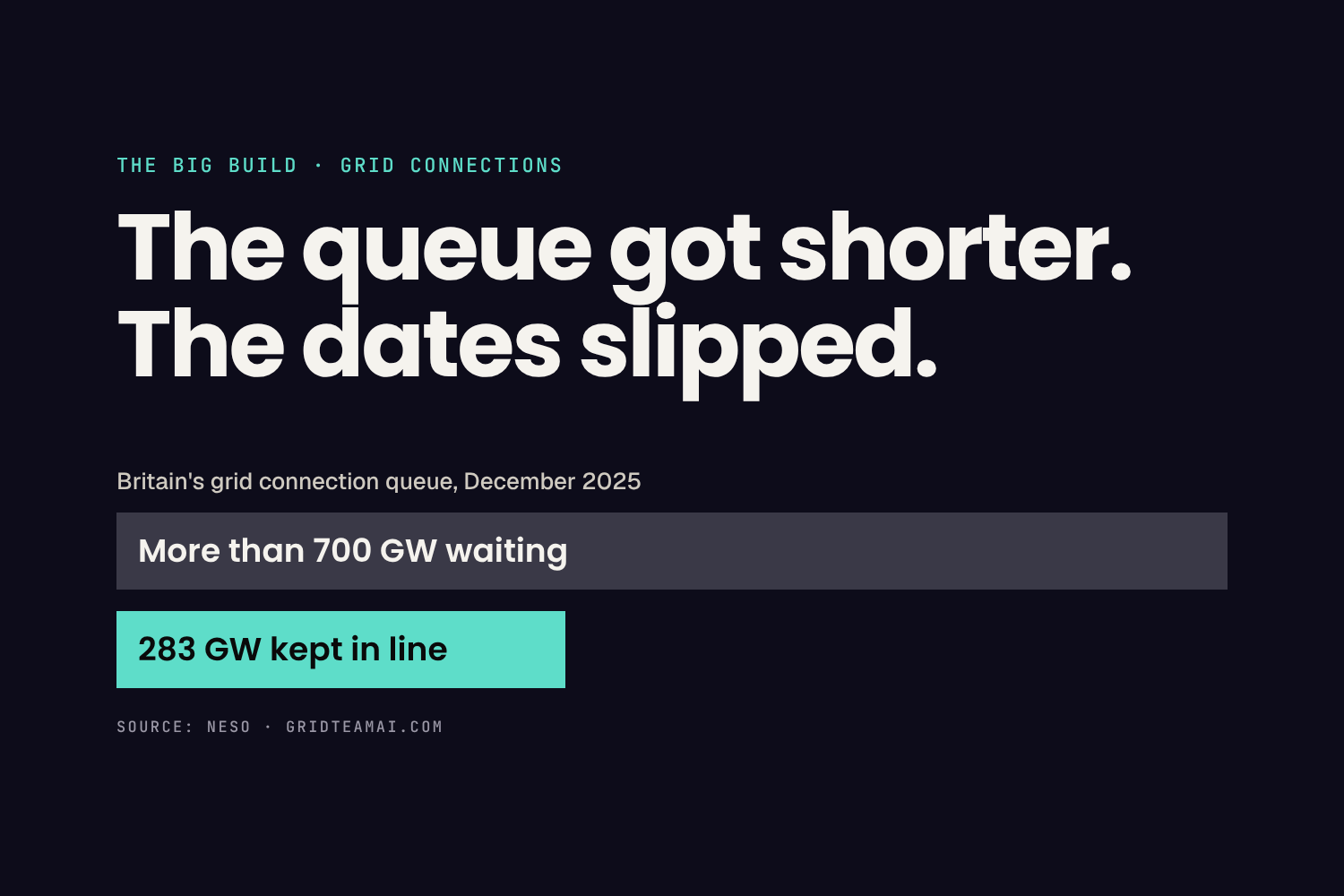
Until last year a place in the queue went to whoever applied first. By December 2025 it held more than 700 gigawatts (GW) of power stations and storage, which NESO put at around four times what Britain needs by 2030. A gigawatt is roughly the output of a large power station, and a megawatt is a thousandth of that.
On 8 December 2025 NESO announced the new pipeline of 283 GW in line for firm offers. Of that, 132 GW is lined up for 2030 and 151 GW for 2035.
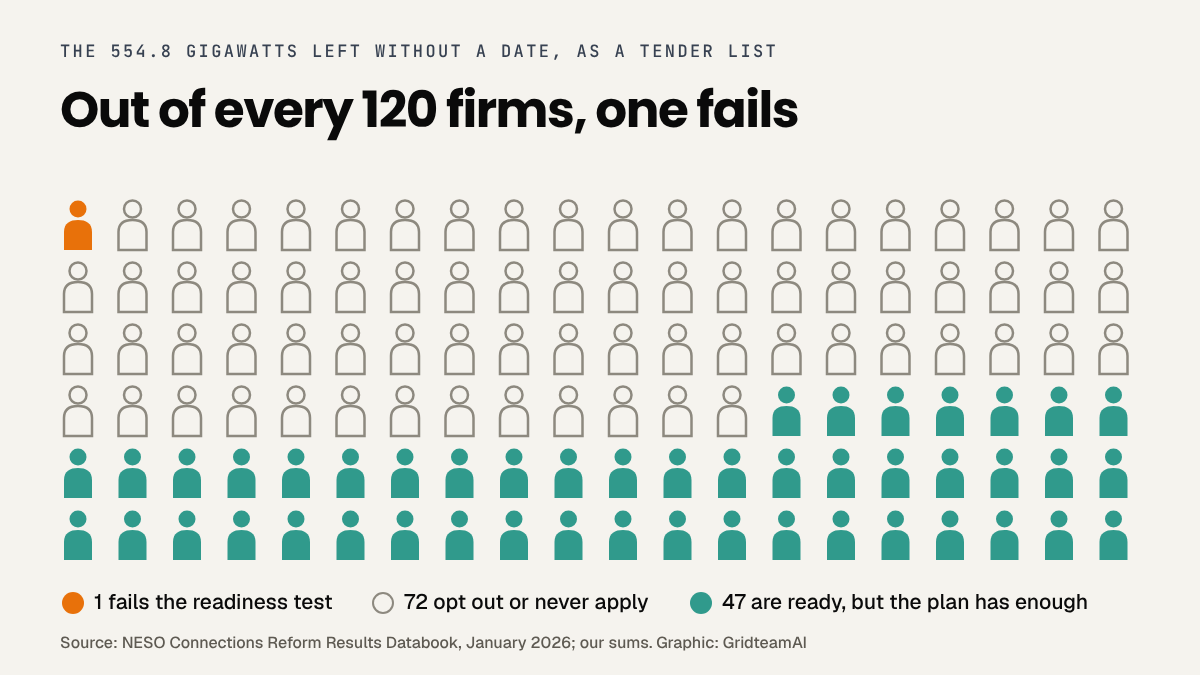
NESO's results data shows what happened to the rest. It lists 554.8 GW with no fixed date, more than the headline drop, which we come back to below. Developers chose that status themselves for 205.7 GW. They never applied at all for another 127.3 GW.
Together that is six-tenths of the 554.8 GW, and NESO's published results do not give their reasons. A further 217.3 GW was ready but went over the limit set for each technology by the Clean Power plan.
Only 4.5 GW formally failed the test of being ready to build. Scale that to a tender list of 120 firms, where one is struck off at pre-qualification and 72 withdraw or never bid. The other 47 pass and are told the client has enough.
Large power users had an easier route. Ofgem's decision treated them as needed by default, though they still had to show they were ready. NESO's data lines up 98.5 GW of them for a firm offer, about 2.2 times Britain's peak demand of 45 GW.
Too many batteries, barely enough wind
The limit bites hardest on batteries. The Clean Power 2030 Action Plan puts the need at 23 to 27 GW by 2030. NESO's data gives 83.2 GW of batteries a place, about three times that, and NESO turned away another 152.9 GW that were ready.
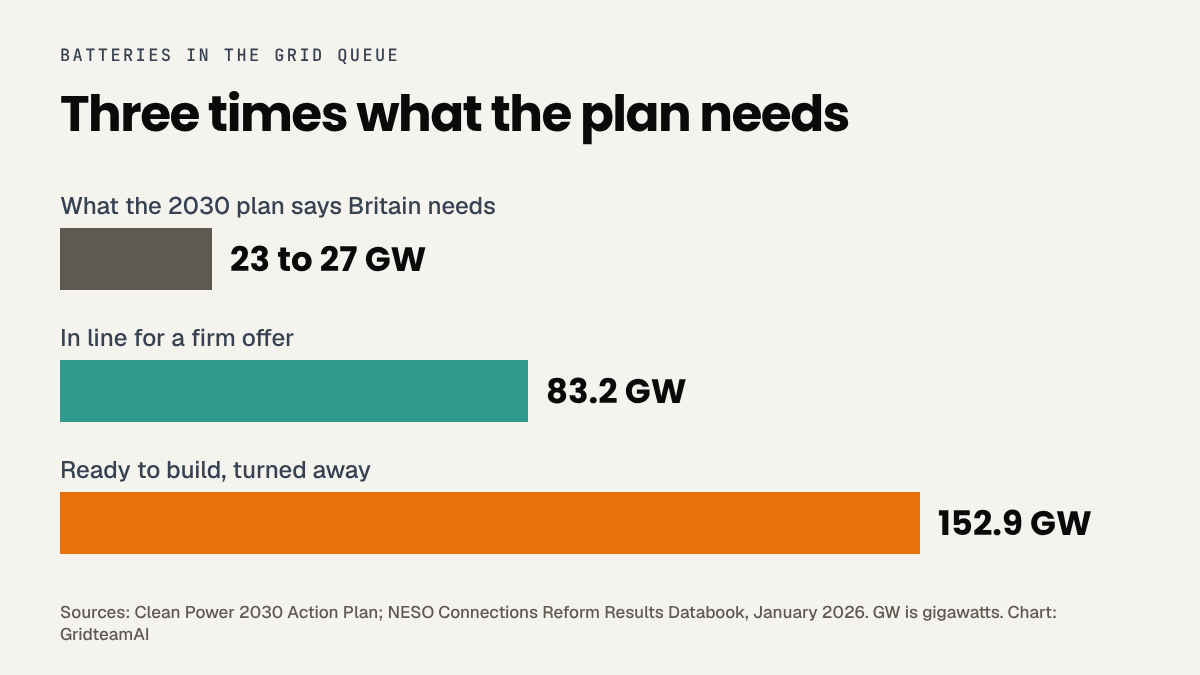
Nearly all of the 83.2 GW got in through the protection rules. Those guaranteed an offer to projects that already held planning consent, the legal permission to build, or a government-backed contract.
In its September consultation, Ofgem cited market forecasts that Britain's battery market could be saturated below 25 GW. It is minded to approve an industry proposal for a refundable commitment fee. The fee starts at £3,000 a megawatt and rises to £25,000.
Ofgem expects to decide later in 2026. When we checked on 16 November, NESO's results page showed no room for new batteries unless they qualify for protection.
Wind is the reverse. Add what NESO counted as built in August 2025 to the offers for 2030, and offshore wind comes to 50.0 GW against the plan's range of 43 to 50. Onshore wind comes to 27.7 GW against 27 to 29.
Ofgem's impact assessment says that under the old queue only 30% to 40% of projects holding an agreement went on to connect. It says NESO added no headroom for drop-outs. Ofgem named the offers for 2035 as the back-up.
The same document says Britain needs to connect about 20 GW a year, against about 8 GW a year achieved.
Staying in the queue is the easy part
Our reading is that reform sorted the paperwork and left the building to come. It limited the queue to what the plan says is needed, protected projects aside, and let developers sort themselves. Who builds depends on planning and finance, and on supply chains and the network arriving on time.
The strongest case against our reading is that the limit is the point. A queue of 283 GW can be studied and planned for in a way that 700 could never be. NESO's March consultation also says batteries are likely to thin out, though that could take several years. We accept that. The test is whether the dates now hold.
What it means for you
Your order book. Treat a firm offer as a lead until the contract is signed and the date holds. Ask your client whether the project was protected and whether its offer has been reissued, as 51% of the first protected offers were. Then ask which network upgrade its date depends on.
Your costs. For a 100-megawatt battery the proposed fee starts at £300,000 and rises to £2.5 million. Ofgem has also proposed a fee for data centres of £237,500 to £712,500 a megawatt. For 100 megawatts that is £23.75 million to £71.25 million, refunded when the site is switched on.
Your programme. NESO's mid-year report says 88% of projects with a 2030 offer will still connect before 2030, so ask your client to show theirs is one of them. NESO had not published a date for the next application round when we checked on 16 November.
Who pays, who gains
Under the proposals developers put up money to hold a place. Under the battery one, any fee a developer forfeits goes back to consumers through network charges. Customers are not compensated when a connection is late, the National Audit Office notes in its September report.
In our view the gainers are protected projects and large power users.
Bill payers carry the cost of a grid that arrives late. Generators are paid to turn output up or down around bottlenecks, which the audit office puts at £1.9 billion in 2025-26. It says that could reach £6.6 billion to £7.8 billion in 2030 if grid upgrades are not accelerated.
The short version
NESO says Britain's queue fell from more than 700 GW to 283 GW. Its own data shows developers stood down six-tenths of what was left without a date, and only 4.5 GW formally failed.
Batteries are in line for firm offers at about three times the 2030 need, while wind has little spare.
In our view an offer is now a ration card. Whether it becomes a power station depends on the network, and 50 of 56 key upgrades are forecast late.
Jargon buster
Gate 2. NESO's name for a firm grid connection offer. It comes with a date and a place, under the rules Ofgem approved in April 2025.
What we don't know yet
The last 2030 offers. Whether NESO sent every one by its 31 October deadline. We found no statement from NESO or Ofgem by 16 November.
The signatures. NESO gives a count, 288 signed by the end of September, but not the capacity or the share.
The gap. NESO's headline of 8 December 2025 runs from more than 700 GW to 283 GW, a drop of about 417 GW. Its table, published with the January 2026 results, lists 554.8 GW without a fixed date. The two figures do not match, and the documents we read do not explain why.
We'll keep score.
Which tells you more about a project, its grid offer or its planning consent? Hit reply and tell us, or leave a comment.
If someone on your bid team still counts grid offers as pipeline, forward this to them.
The Wire covers UK and Irish infrastructure news every weekday morning, and it's free. Our Energy and Grid page follows the network build, and the live map tracks more than 1,000 projects.
Next week: the January price cap, taken apart.
If this was useful, tap the heart. It helps the issue reach new readers.
See you next week.
Anthony
Sources
NESO, Connections Reform Results Databook, accompanying the January 2026 detailed results report (firm and indicative offer totals by technology and reason; protected projects): https://www.neso.energy/document/374931/download
NESO, "NESO implements electricity grid connection reforms to unlock investment in Great Britain", 8 December 2025 (more than 700 GW, around four times 2030 need; 283 GW, 132 GW and 151 GW): https://www.neso.energy/neso-implements-electricity-grid-connection-reforms-unlock-investment-great-britain
Ofgem, Summary Decision Document on the connections reform package, 15 April 2025 (the two gates; protections; demand-only projects deemed needed, subject to readiness): https://www.ofgem.gov.uk/sites/default/files/2025-04/Summary-Decision-Document-TMO4-package.pdf
Department for Energy Security and Net Zero, Clean Power 2030 Action Plan, 13 December 2024, updated 15 April 2025 (capacity ranges for 2030: batteries 23 to 27 GW, offshore wind 43 to 50, onshore wind 27 to 29): https://www.gov.uk/government/publications/clean-power-2030-action-plan/clean-power-2030-action-plan-a-new-era-of-clean-electricity-main-report
Ofgem, minded-to consultation on an Oversubscribed Technologies Commitment Fee, 17 September 2026 (battery market forecasts below 25 GW; a refundable fee of £3,000 rising to £25,000 a megawatt, proposed by industry; forfeited fees returned through network charges): https://www.ofgem.gov.uk/sites/default/files/2026-09/CMP470-Minded-to-Consultation.pdf
NESO, Connections Reform Results page, read 16 November 2026 (no permitted capacity for new batteries unless protected): https://www.neso.energy/industry-information/connections-reform/connections-reform-results
NESO, Connections Reform Detailed Results Data, January 2026 (capacity built at August 2025): https://www.neso.energy/document/374936/download
Ofgem, Impact Assessment on the connections reform package, 15 April 2025 (30% to 40% of contracted projects historically connect; no allowance for attrition, with 2035 offers as the back-up; about 20 GW a year needed against about 8 GW achieved): https://www.ofgem.gov.uk/sites/default/files/2025-04/TMO4-Impact-Assessment-Decision_0.pdf
Ofgem, update on delays to connection dates for some protected projects, 6 February 2026 (210 of 340 projects): https://www.ofgem.gov.uk/sites/default/files/2026-02/Ofgem-Response-on-Protected-Projects-Relief-Request.pdf
NESO, Mid-Year 2026-27 Incentives Report, 23 October 2026 (51% of pre-2028 protected offers reissued; 91% of Gate 2 Phase 1 offers issued and 288 Gate 2 offers contracted at end September; 88% of Phase 1 projects still connected before 2030): https://www.neso.energy/document/389226/download
Ofgem, agreement on a revised timetable for Gate 2 offers, 2 October 2026 (deadlines of 31 October 2026, 31 January 2027 and 31 March 2027): https://www.ofgem.gov.uk/sites/default/files/2026-10/Ofgem-agreement-for-revision-to-G2TWQ-timetable.pdf
NESO, "What industry needs next from connections reform", 1 October 2026: https://www.neso.energy/news/what-industry-needs-next-connections-reform
National Audit Office, "Upgrading the electricity transmission network", 11 September 2026 (50 of 56 projects forecast after their optimal date; connection speeds not tracked; no compensation for late connections; constraint costs): https://www.nao.org.uk/wp-content/uploads/2026/09/Upgrading-the-electricity-transmission-network.pdf
Ofgem, consultation on data centre connection reforms, 29 July 2026 (peak demand 45 GW; commitment fee of £237,500 to £712,500 a megawatt, refunded at energisation): https://www.ofgem.gov.uk/sites/default/files/2026-07/Proposed-data-centre-connection-reforms-curate-consultation-document.pdf
NESO, Connections Methodologies Annual Consultation, 17 March 2026 (battery attrition likely but could take several years): https://www.neso.energy/document/378746/download
NESO, Connections Reform Timeline graphic, 2025 (all Gate 2 offers no later than the end of the third quarter of 2026), and NESO's connections reform timeline page, read 16 November 2026 (no date for the next application window): https://www.neso.energy/document/369506/download and https://www.neso.energy/industry-information/connections-reform/connections-reform-timeline
Ofgem, "Ofgem moves to free up grid capacity by tackling excess battery projects", 17 September 2026 (final decision expected later in 2026): https://www.ofgem.gov.uk/press-release/ofgem-moves-free-grid-capacity-tackling-excess-battery-projects
Our sums, from items 1, 4, 5, 7, 9 and 14. Protected projects: 210 of 340 is 62%, about six in ten. Stood down is 205.7 plus 127.3, which is 333.0 GW and 60% of 554.8. Batteries are 83.2 divided by 27, which is 3.1. Readiness failures are 4.5 of 554.8 GW, about 1 in 120, and on a list of 120 the 333.0 GW that opted out is 72 and the 217.3 GW is 47. Built plus 2030 offers are 17,971.2 plus 32,072.6 megawatts for offshore wind and 14,644.4 plus 13,061.9 for onshore wind. Large power users are 98.5 divided by 45, which is 2.2. Fees for 100 megawatts are £3,000 and £25,000 times 100, and £237,500 and £712,500 times 100. From more than 700 GW to 283 GW is a drop of about 417 GW: https://www.neso.energy/document/374931/download