


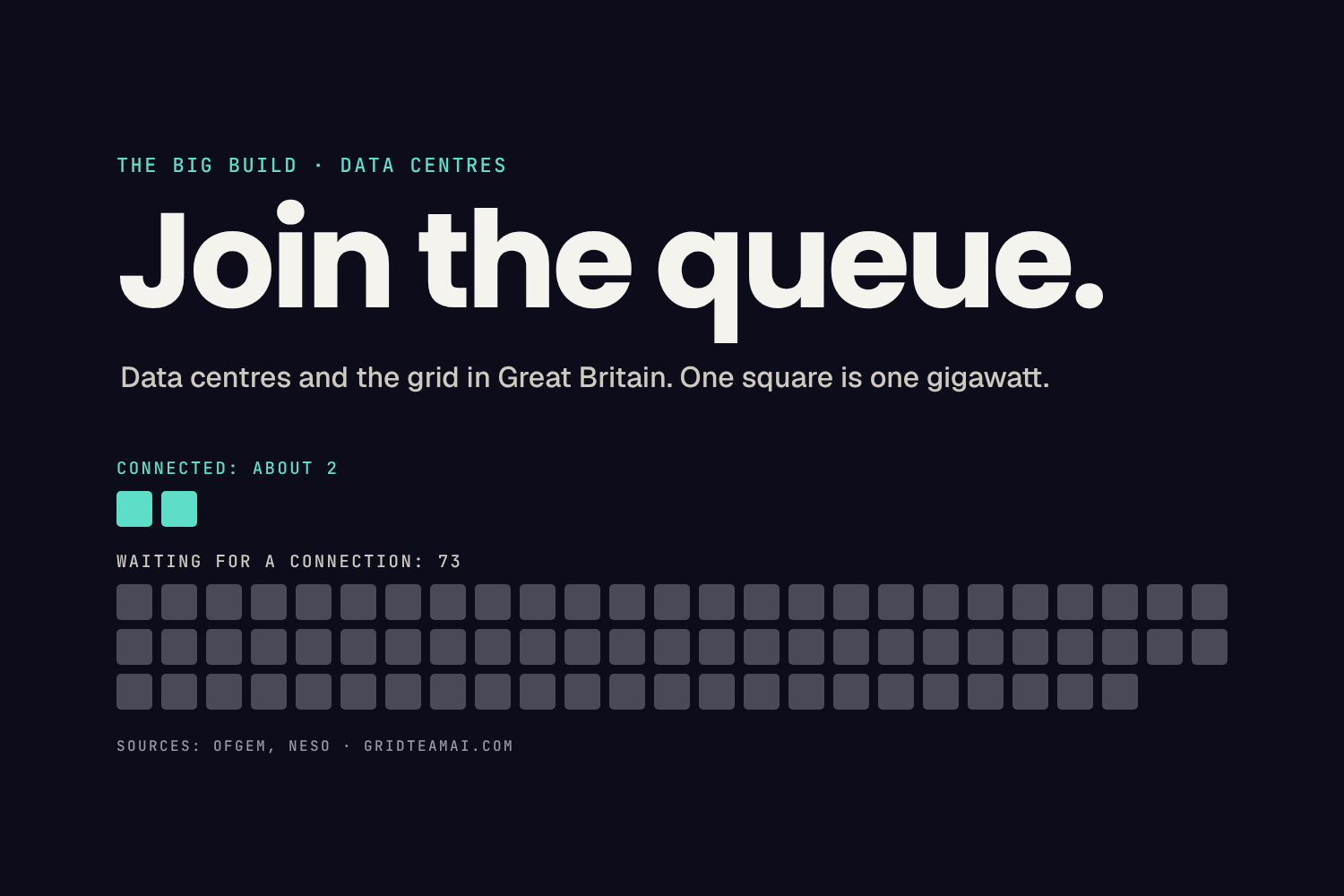

Turn to page 13 of the consultation that Ofgem, the energy regulator, published on 29 July 2026. It counts who is waiting for a grid connection in Great Britain.
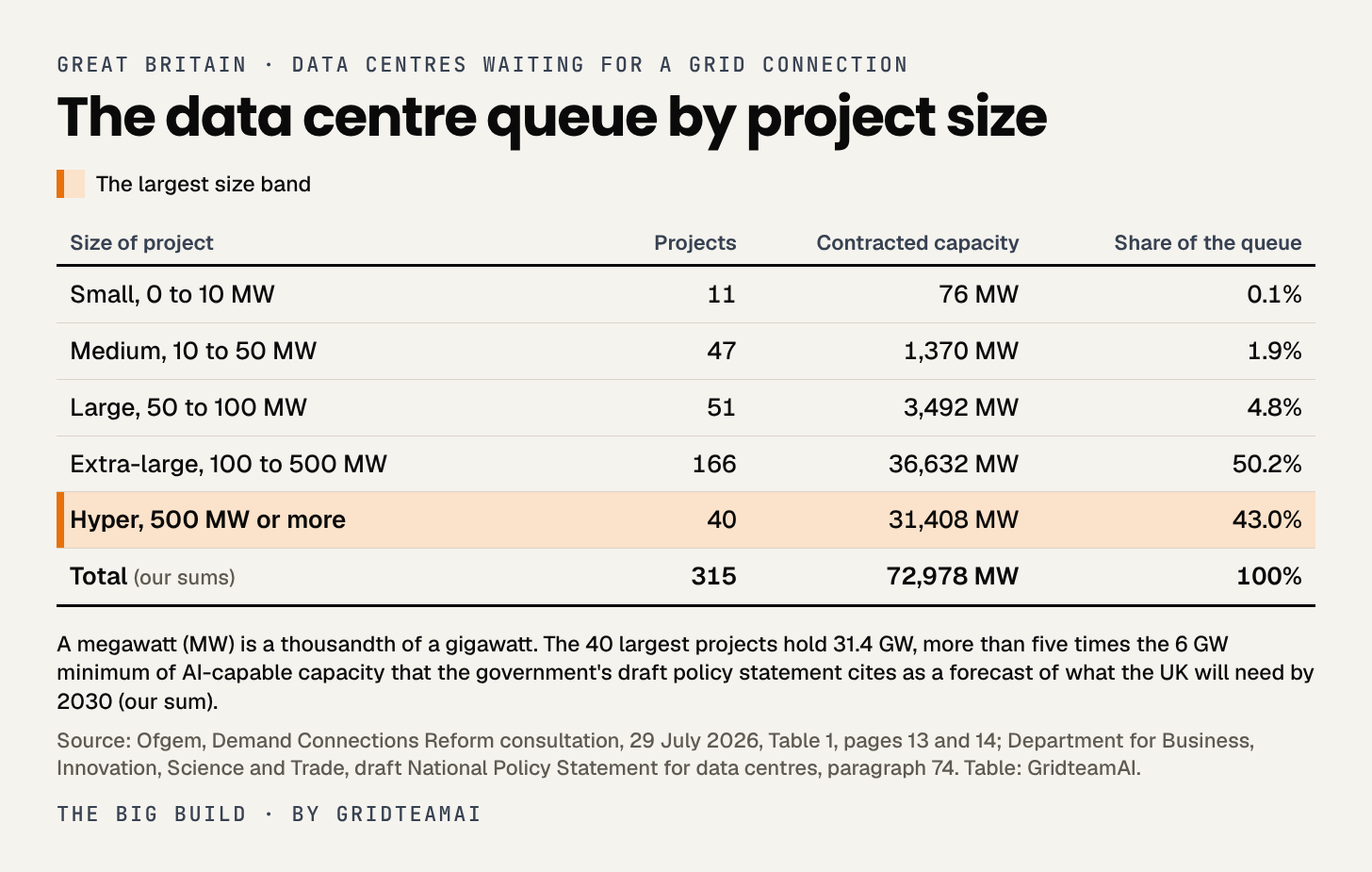
Paragraph 2.6 says offers in the demand queue "rose sharply from 41 GW" to 125 GW between November 2024 and June 2025. A gigawatt (GW) is roughly the output of a large power station. Paragraph 2.7 says "approximately 73 GW" of that is data centres, "comprising around 315 data centre projects". Table 1 sorts them by size in megawatts (MW), thousandths of a gigawatt, and its last row, over the page, has 40 projects of 500 MW or more. Between them they ask for 31,408 MW, which Ofgem prints as 43.0% of the data centre queue.
In our view Britain's data centre boom is so far a queue for grid connections, with little yet built, and the official counts below show it. Count the buildings. If your pipeline list was built from grid applications or press announcements, it is counting places in a queue.
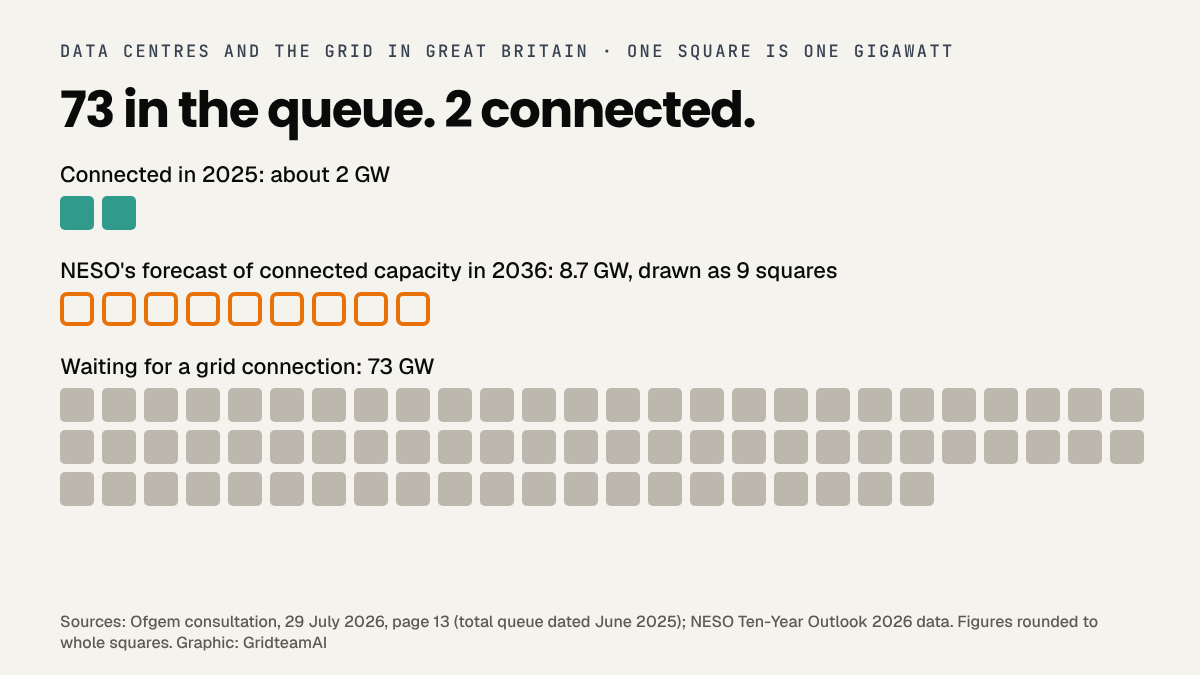
The number: 73. That is how many gigawatts (GW) of data centres were waiting for a grid connection in Great Britain, 1.6 times the 45 GW Ofgem gives as Great Britain's peak demand. Our sum: 73 divided by 45 is 1.6.
Page 5 gives the 45 GW as peak demand. Page 14 dates it to winter 2025/26. Ofgem dates the 125 GW total to June 2025 and gives no separate date for the 73 GW.
The spending is American, and it is real
The UK's part was announced in September 2025. A government press release put it at "a combined £31 billion" from US technology firms, including $30 billion from Microsoft over four years.
Now the firms' own money, in US dollars as they report it. Amazon's third-quarter release, under Financial Guidance, expects capital spending of about $220 billion in 2026. Meta's release, under CFO Outlook Commentary, gives $135 billion to $145 billion. Together that is $355 billion to $365 billion.

No company document we read splits spending by country, so we cannot calculate the UK's share.
The queue is 36 times what is connected
Set the 73 GW against what exists. Paragraph 71 of the government's draft National Policy Statement, on page 18, counts "more than 220 data centres and around 2 GW of capacity". The National Energy System Operator (NESO) has 2.0 GW connected in Great Britain in 2025, in the capacity row of its outlook data. On either count the queue is about 36 times what is connected.
Page 2 of the official statistics puts data centres' grid electricity use at 4.5 terawatt-hours (TWh) in 2024, up from 3.2 in 2020. A terawatt-hour is a billion of the units on your bill.
NESO forecasts nothing like the queue. Slide 17 of its September slides has data centres using 5.4 TWh in 2026, 14.6 TWh in 2031 and 23.5 TWh in 2036. Its data table has connected capacity reaching 8.7 GW in 2036. Slide 16 says the pipeline "is likely to significantly overstate peak data centre demand".
Large users here pay double Europe's median for power
Little of the queue has been built. In our view the best single explanation is the electricity bill.
Table 5.4.4 of the government's price tables covers very large business users, including taxes. Its last row is July to December 2025. The UK paid 21.76p a unit. The median of the 14 countries reporting was 10.47p, with France at 6.23p and Ireland at 15.02p. The UK was the dearest of the 14.
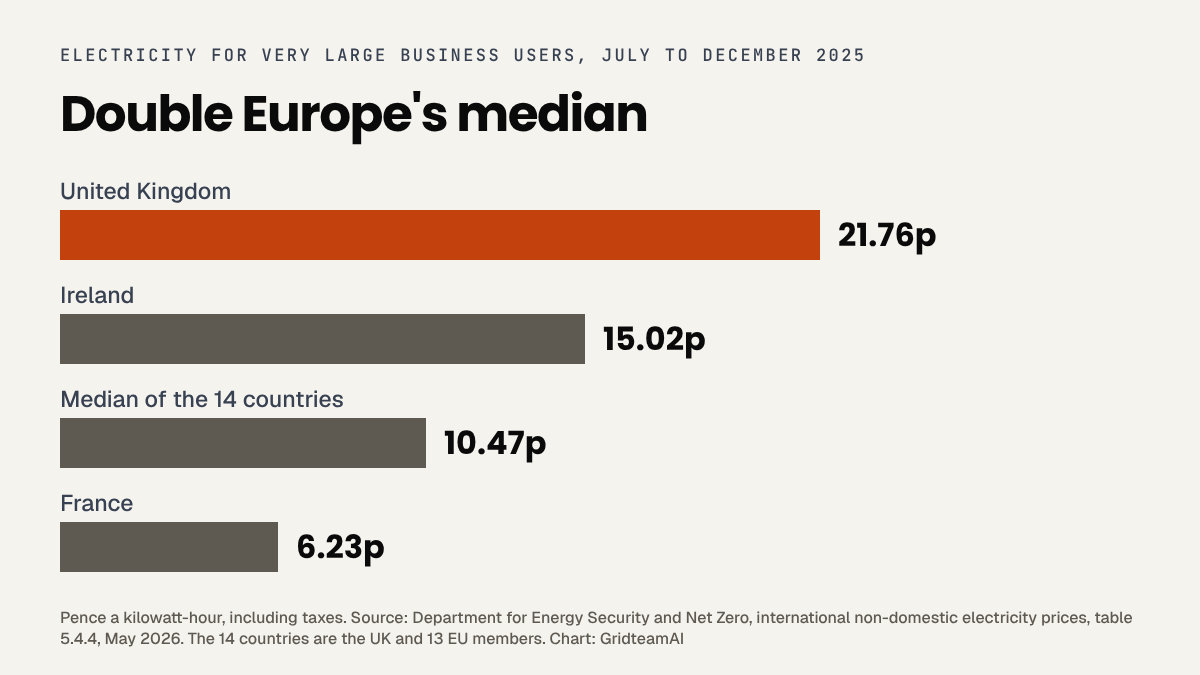
That is 2.1 times the median and 3.5 times France. A data centre is, to a first approximation, a building that turns electricity into invoices.
Help was promised, in small sizes. Section 3 of the AI Growth Zones paper of November 2025 offers up to £24 a megawatt-hour off in Scotland and up to £14 in the North East from April 2027, "subject to legislative timetables". A megawatt-hour is 1,000 units, and the gap to the median is about £113. On our sum the discount closes 21% and 12% of it, though the two are not measured on an identical basis.
We cannot show that price decided any one project, and we do not claim it. OpenAI's statement on pausing its Stargate UK data centre project, as reported in April, said it would move forward when "the right conditions such as regulation and the cost of energy" allow.
Ofgem proposes a fee to stay in the queue
Paragraph 4.1 of Ofgem's consultation, on page 24, proposes a commitment fee of "£237,500/MW to £712,500/MW", or around 2.5% to 7.5% of its assumed build cost of £9.5 million a megawatt. A 100 MW project "will have to secure £23.8 million to £71.3 million". The money is returned if the project proceeds as planned, and paragraph 5.27 passes forfeited sums back to consumers through lower transmission charges.
The fee would apply from 40 MW. Paragraph 5.4, on page 36, says "99% of the total capacity in the queue is composed of projects above 40 MW". Run the sum across the queue. Seventy-three thousand megawatts would need £17.3 billion to £52.0 billion in fees. Page 14 puts the cost of building all of it at £693 billion, some 22 times the £31 billion package.
Paragraph 9.2, on page 75, says Ofgem intends "to take decisions later in 2026", which leaves about six weeks. Our reading: if Ofgem goes ahead, we expect much of the queue to step out rather than show its money.
The case against
The best objection is that a queue is counted in peak megawatts and a forecast in annual energy, so we are setting a peak against an average. NESO's evidence to Parliament, in its section on ramp rates, suggests data centres take an average of seven years to ramp up once connected.
Shortage is also real. In June the Secretary of State allowed a data centre at Slough, and paragraph 17 of the decision letter agrees unmet need of 1,259 MW there. Paragraph 74 of the draft policy statement cites a forecast that the UK will need "at least 6GW of AI-capable data centre capacity by 2030". And the price table stops at users of about 17 MW, so a 100 MW campus on a privately negotiated contract may pay less.
Our answer is to set capacity against capacity. The accepted Slough shortage is under 2% of the queue, and the government's 6 GW is about 8%. The 40 largest projects in Ofgem's Table 1 ask for 31.4 GW on their own, five times that 6 GW. The official statements of need we found describe a market a fraction the size of the queue.
What it means for you
Your order book. Page 2 of NESO's call for input summary says 68% of data centre projects had not secured a customer. Mark each data centre lead for three things: planning permission, a named customer and a dated grid connection.
Your costs. On Ofgem's range, a 100 MW scheme posts at least £23.8 million. Ask your client whether that is in the budget.
Who pays, who gains. Developers holding a place without a funded project would pay first, in fees or a lost place. Landowners may follow. Paragraph 2.13 of Ofgem's consultation says land values rise "once planning permission and a grid connection have been secured". In our view the gainers would be funded projects with customers, which face a shorter queue.
How we could be wrong
The fee, 31 December 2026. Ofgem intends to decide by then. If it drops the fee, this test lapses. If it goes ahead and most of the 73 GW later pays and stays, the queue was real.
The price, 26 November 2026. The price table is next updated that day. If the UK leaves last place, our price argument goes.
The meter, 2027. The energy department plans to publish 2025 figures in 2027. If they show use running well ahead of NESO's path to 5.4 TWh in 2026, we are wrong.
The switch, November 2027. If a campus of 100 MW or more is switched on in an AI Growth Zone by then, or Stargate UK restarts with a firm power date before 2030, score one against us.
We do not know the speculative share. Neither Ofgem nor NESO has published a measured figure that we could find. And Ofgem's consultation says about 73 GW where its press release of the same day says "at least 80GWs". The documents we read do not explain the difference.
The short version
Data centres have asked for 73 GW. About 2 GW is connected, and NESO's data has 8.7 GW by 2036.
Very large users paid 21.76p a unit in late 2025, 2.1 times the European median, and Ofgem's fee would ask the queue for £17.3 billion to £52.0 billion.
Count the buildings.
We'll keep score.
How many of the data centre jobs on your list have a named customer? Hit reply and tell us.
If a colleague still counts grid applications as pipeline, forward this to them.
The Wire covers UK and Irish infrastructure news every weekday morning, and it's free. Our Data Centres page follows the build, and the live map tracks more than 1,000 projects.
Next week: Ireland's grid, and the dates printed for it.
See you next week.
Anthony
Sources
Ofgem, "Curate: Demand Connections Reform" consultation document, 29 July 2026 (page 5: queue up from 41 GW to 125 GW between November 2024 and June 2025, "around 73 GW are data centres", "peak demand in Great Britain in 2025 was 45 GW"; page 14: "Peak GB electricity demand in 2025/26 was 45 GW"; page 6: "approximately £237,500 to £712,500 per MW", the fee "will be returned if the project proceeds as planned", "we intend to take decisions later in 2026"; paragraphs 2.6 and 2.7, page 13: "rose sharply from 41 GW", "approximately 73 GW of the total demand queue are data centres, comprising around 315 data centre projects"; Table 1, pages 13 and 14: five size bands, the last being 40 projects of 500 MW or more with 31,408 MW, 43.0% of the data centre queue; page 14: "£693 billion of implied total capex"; paragraph 2.13, page 15: land value increasing "significantly once planning permission and a grid connection have been secured"; paragraph 4.1, page 24: "£237,500/MW to £712,500/MW", "around 2.5% to 7.5%" of "£9,500,000 per MW", and a 100 MW project "will have to secure £23.8 million to £71.3 million"; paragraph 5.1, page 35: "equal to or above 40 MW"; paragraph 5.4, page 36: "99% of the total capacity in the queue is composed of projects above 40 MW"; paragraph 5.27, page 41: forfeited securities passed "back to consumers through consequent reductions in transmission network use of system charges"; paragraph 9.2, page 75: "we intend to take decisions later in 2026"): https://www.ofgem.gov.uk/sites/default/files/2026-07/Proposed-data-centre-connection-reforms-curate-consultation-document.pdf
Ofgem, press release "Ofgem acts to free up grid capacity by tackling speculative data centre projects", 29 July 2026 ("at least 80GWs"): https://www.ofgem.gov.uk/press-release/ofgem-acts-free-grid-capacity-tackling-speculative-data-centre-projects
Department for Energy Security and Net Zero, Digest of UK Energy Statistics 2026, Chapter 5: Electricity (page 2: data centres "accounted for an estimated 4.5 TWh of electricity consumed from the grid in Great Britain in 2024, up from 3.2 TWh in 2020"): https://assets.publishing.service.gov.uk/media/6aba96e8997a4b2950ccf02c/DUKES_2026_Chapter_5.pdf
UK government, Draft National Policy Statement for Data Centres, October 2026 (paragraph 71, page 18: "an estimated more than 220 data centres and around 2 GW of capacity"; paragraph 74, page 19: "at least 6GW of AI-capable data centre capacity by 2030"): https://assets.publishing.service.gov.uk/media/6ae1c5937fe45a08a4036e4e/draft-national-policy-statement-for-data-centres.pdf
NESO, Electricity Markets Advisory Council slides, 22 September 2026 (slide 16: the data centre pipeline "is likely to significantly overstate peak data centre demand"; slide 17: data centres at 5.4 TWh in 2026, 14.6 TWh in 2031 and 23.5 TWh in 2036): https://www.neso.energy/document/388756/download
NESO, Ten-Year Outlook 2026 electricity demand summary data table, read 18 November 2026 (row "Data Centres", annual demand: 5,426 gigawatt-hours in 2026, 14,639 in 2031 and 23,489 in 2036; row "Data Centre Total Connected Capacity": 2.02 GW in 2025 and 8.74 GW in 2036): https://www.neso.energy/data-portal/fes-electricity-demand-summary-data-table-ed1/electricity_demand_summary_ed1_2026
NESO, Demand Call for Input: High Level Summary, March 2026 (page 2: "Only 32% of data centre projects have secured off-takers, while 68% have not yet secured one"): https://www.neso.energy/document/378226/download
NESO, written evidence DCU0081 to the Environmental Audit Committee, undated (section 2, "Ramp rates": an average ramp rate "of seven years"): https://committees.parliament.uk/writtenevidence/166090/html/
Department for Energy Security and Net Zero, international non-domestic electricity prices, table 5.4.4, published 28 May 2026, next update 26 November 2026 (sheet "5.4.4 (Very Large incl tax)", row for July to December 2025: UK 21.76p, median 10.47p, France 6.23p, Ireland 15.02p; UK ranked 14 of 14; the band is 70,000 to 150,000 megawatt-hours a year): https://assets.publishing.service.gov.uk/media/6a1565099819be865f421cda/table_541.xlsx
Department for Science, Innovation and Technology, "Delivering AI Growth Zones", 13 November 2025 (section 3, "Bringing down energy prices": up to £24 a megawatt-hour in Scotland and up to £14 in the North East, for data centres in AI Growth Zones, "From April 2027, subject to legislative timetables"): https://www.gov.uk/government/publications/delivering-ai-growth-zones/delivering-ai-growth-zones
Amazon, third-quarter results, 29 October 2026 (Financial Guidance: "We continue to expect 2026 cash capital expenditures to be approximately $220 billion."): https://aboutamazon.com/news/company-news/amazon-earnings-q3-2026-report
Meta, third-quarter results, 21 October 2026 (CFO Outlook Commentary: 2026 capital expenditures "in the range of $135-145 billion"): https://investor.atmeta.com/investor-news/press-release-details/2026/Meta-Reports-Third-Quarter-2026-Results/
GOV.UK, "US-UK pact will boost advances in drug discovery, create tens of thousands of jobs and transform lives", 16 September 2025 ("a combined £31 billion"; Microsoft "investing more than $30 billion over 4 years"): https://www.gov.uk/government/news/us-uk-pact-will-boost-advances-in-drug-discovery-create-tens-of-thousands-of-jobs-and-transform-lives
The Register, 9 April 2026, a press report printing a statement the company sent to it (OpenAI's pause of Stargate UK): https://www.theregister.com/2026/04/09/openai_puts_stargate_uk_on/
Ministry of Housing, Communities and Local Government, decision letter on Manor Farm, Slough, 10 June 2026 (paragraph 17, page 3: the Secretary of State "agrees the unmet need for data centre capacity in the SAZ is 1,259 MW"): https://assets.publishing.service.gov.uk/media/6a292d6edb0592d809052b94/260610_Combined_DL_IR_RtoC_-_Manor_Farm_Slough_-_3366043.pdf
Department for Energy Security and Net Zero, Energy Trends special feature article on data centre electricity consumption in Great Britain, 30 June 2026 (page 5 of the article: "We plan to update our estimates in 2027 to include 2025 electricity" data): https://www.gov.uk/government/publications/energy-trends-june-2026-special-feature-article-data-centre-electricity-consumption-in-great-britain-2020-to-2024
Our sums, from items 1, 4, 6, 9 to 13 and 15. Queue against peak: 73 divided by 45 is 1.6. Queue against connected capacity: 73 divided by 2 is 36.5, about 36. Two firms: 220 plus 135 is 355, and 220 plus 145 is 365. Price multiples: 21.76 divided by 10.47 is 2.1, and divided by 6.23 is 3.5. Price gap: 21.76 less 10.47 is 11.29p a kilowatt-hour, about £113 a megawatt-hour; 24 divided by 113 is 21% and 14 divided by 113 is 12%. Fees: 73,000 MW times £237,500 is £17.3 billion, and times £712,500 is £52.0 billion. Build cost: Ofgem prints £693 billion, and 693 divided by 31 is 22. Slough: 1,259 MW divided by 73,000 MW is 1.7%, under 2%. Government need: 6 divided by 73 is 8%. The 40 largest: 31,408 MW is 31.4 GW, and 31.4 divided by 6 is 5.2, about five times. Top price band: 150,000 megawatt-hours divided by 8,760 hours is 17 MW. Time left: 20 November to 31 December 2026 is 41 days, about six weeks: https://www.ofgem.gov.uk/sites/default/files/2026-07/Proposed-data-centre-connection-reforms-curate-consultation-document.pdf